International and Accredited Schools in Nicaragua: The Real Options for Expat Kids
Updated September 2026
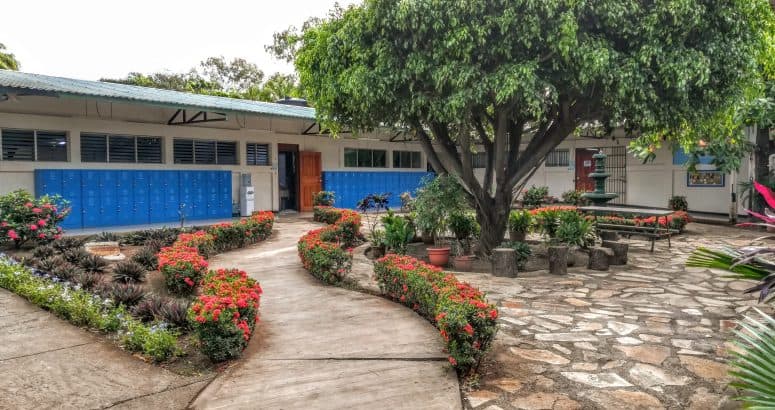
If you're moving to Nicaragua with kids, schooling ends up being the single biggest factor in where you actually settle, more than rent, more than the beach, more than anything else on the list. And the honest answer is that almost every accredited option worth considering is in Managua.
Why Managua, specifically
Nicaragua has one legitimately international, PreK-12, bilingual day school outside the capital: San Juan del Sur Day School. Every other accredited option on this list, all eight of them, is in Managua. That's not a coincidence. Accredited international schools need a large enough pool of expat, diplomatic, and bilingual local families to sustain a real campus, real facilities, and a real teaching staff, and Managua is the only city in the country with that critical mass.
If you're weighing SJDS, Granada, León, or Matagalpa against Managua and school-age kids are part of the picture, this is the deciding factor for most families. The coastal and colonial towns are genuinely better for a lot of things. School options aren't one of them, unless you're comfortable homeschooling or driving your kids into Managua daily, which nobody actually does.
The accredited international schools in Nicaragua
American Nicaraguan School (ANS), Managua. Founded 1944, roughly 900 students from over 30 nationalities on a 26-acre campus in Lomas de Monserrat. Fully English-language American curriculum with a strong AP program. Accredited by Cognia and by MINED. Graduates receive a Dual Diploma: a US High School Diploma alongside the Nicaraguan Bachillerato. This is the school most American and Canadian expat families default to.
Colegio Alemán Nicaragüense (German School), Managua. Founded in the 1960s, ages 1 to 18, around 600 students. Instruction in German and Spanish, with English as a third language. This is the only IB World School in Nicaragua, offering the full International Baccalaureate Diploma Programme with a bilingual track. Officially recognized by Germany as a School Abroad. Students can also sit the DSD language diplomas, which open direct access to German universities. If you want your child to have a genuine IB Diploma on their transcript, this is currently the only school in the country that offers it.
Nicaragua Christian Academy International (NCA), Managua. About 280 students on a seven-acre campus southwest of the city. English-language, American college-prep curriculum with a North American calendar and AP courses (Calculus AB, English Language and Composition, English Literature, Spanish Language, Spanish Literature/Culture, Statistics). Accredited by Cognia and by ACSI, the first Central American school to hold ACSI accreditation. Evangelical, non-denominational, nonprofit. This is genuinely one of the best options on this list: tuition runs noticeably lower than ANS or the German School, and it has a real track record of sending graduates on to universities in Canada and the US, including several who went on to play sports at the collegiate level.
Nicaragua Christian Academy Nejapa, on the southwestern edge of Managua. A separate, more affordable NCA campus of around 540 students, teaching primarily in Spanish with daily English from grade 5 up and a MINED-based curriculum with biblical integration. As of this writing it's in the final stages of ACSI accreditation, not yet fully accredited the way the International campus is, worth confirming current status directly if this is the one you're considering.
Lincoln International Academy, Las Colinas Sur, Managua. Catholic, bilingual, PreK-12, founded 1991. Runs a STREAM framework (Science, Religion, Technology, Engineering, Arts, Math). Accredited by Cognia (SACS), holds Cognia STEM and American School certifications, and is MINED-accredited.
St. Augustine Preparatory School, Managua. Catholic, college-prep, bilingual. Accredited by NEASC and MINED. Runs a Core Knowledge curriculum in the early grades and a genuinely rigorous AP pathway later, including the AP Capstone Diploma, and became the second school in Central America to offer it. In 2023, 85 percent of seniors earned the Capstone Diploma, which is a real number worth knowing if academic intensity matters to you.
Lycée Franco-Nicaraguayen Victor Hugo, west of Managua. Founded 1971, follows the actual French national curriculum through the baccalaureate. Affiliated with AEFE, the agency overseeing French schools abroad, part of a network spanning 139 countries. Students study French, English, Spanish, Portuguese, and Chinese. The obvious choice for French families or anyone wanting their kids to keep a real shot at French university admission.
Colegio Teresiano de Managua, Managua. Spanish-language with a bilingual program, Catholic, founded 1954. Its high school diploma has been recognized for English-language issuance since 1959. More locally oriented than the other schools on this list, but a long-established, credible option if full immersion in Spanish is actually what you want for your kids.
San Juan del Sur Day School, the one option outside the capital. PreK-12, bilingual English-Spanish, on a 10-acre farm campus with a sustainability focus. Offers a Cognia International Diploma alongside the Nicaraguan MINED diploma. Genuinely good, but smaller and less established than the Managua schools, and the only real option if you're committed to living on the coast with school-age kids.
One more worth knowing about, outside the accredited tier
Colegio Cristiano La Verde Sonrisa, Managua. Spanish-medium, Christian, MINED-registered, running preschool through secondary. It doesn't carry Cognia, ACSI, NEASC, or IB accreditation the way the schools above do, so it isn't the pick if a foreign-recognized diploma is the priority. What it does offer is very good value for a central Managua location, strong programs and administration by local reputation, and facilities that stand out even next to the pricier schools, including a genuine Olympic-size swimming pool with its own swim school open to the public on weekdays and Saturdays. It also runs an afternoon inclusive-education program for children with autism, Asperger's, and Down syndrome, one the school describes as the first of its kind in Nicaragua, and by its own account many of its graduates go on to technical schools and university.
Why the accreditation actually matters
This is the part people underestimate. The Nicaraguan Bachillerato on its own, MINED-issued with no other accreditation layered on top, is a valid local diploma, but it isn't automatically recognized by university admissions offices in the US, Canada, or Europe the way a diploma from an internationally accredited school is.
What actually gets a foreign university to take a transcript seriously without extra hoops:
A recognized accrediting body alongside MINED. Cognia (the accreditor behind ANS, NCA, Lincoln, and San Juan del Sur Day School), NEASC (St. Augustine), and ACSI (NCA) are all bodies that US and Canadian university admissions offices already know and trust. A diploma carrying one of these means an admissions office doesn't have to independently evaluate an unfamiliar foreign school from scratch.
An actual IB Diploma, which only Colegio Alemán currently offers in Nicaragua, is recognized directly by essentially every university in the world, including highly selective ones, without any additional credential evaluation. If your long-term plan is a competitive university abroad, this is the single strongest credential available in the country right now.
A Dual Diploma, like the one ANS issues, which pairs a genuine US High School Diploma with the Nicaraguan Bachillerato. This is the most direct path if the plan is specifically US college admission, since it's a diploma format American universities process routinely.
AP courses and the AP Capstone Diploma, offered at ANS, NCA, and especially St. Augustine, function as both college credit and a signal of academic rigor that US and Canadian admissions offices weigh directly.
A real national curriculum tie, like the Lycée's AEFE affiliation, matters specifically if the destination is that country's own university system. A French baccalaureate from an AEFE school transfers into French higher education in a way a generic international diploma doesn't.
If your child finishes high school at a school with none of the above, just MINED accreditation on its own, you're not locked out of studying abroad, but you're looking at a credential evaluation service, standardized testing to fill gaps, and a slower, less certain admissions process. For families explicitly planning on university abroad after graduation, that's the real reason to pay the premium for one of the accredited schools above rather than a purely local option.
Figuring out where to actually live once schooling is settled? The where to live in Nicaragua guide and the complete Managua-focused planning resources cover the rest of the decision. And if you're still weighing Managua against the coast, talk to us before you commit to a neighborhood around a specific school.
Sources: American Nicaraguan School, U.S. Department of State, American Nicaraguan School Fact Sheet, International Baccalaureate, Deutsche Schule Managua / Colegio Alemán Nicaragüense, NCA International, doris, Compare Secondary Schools in Nicaragua
Ready to take the next step?
Talk to someone who has done it
Every move is different. Book a free orientation call and we will give you a straight read on whether Nicaragua is the right fit for your situation.
Book a free call →