I should be upfront about the shape I was in the first time I tried mondongo.
The night before, a German friend and I had put down two full crates of Toñas at a roadside bar. Dirt floor, plastic chairs, plastic table, one bulb overhead. Norteño music blasting out of a blown floor standing bluetooth speaker all night. Roosters wandered around, pecking at the ground. Thin stray cats weaved between your legs looking for any scraps. The bartender stacks the empties next to you so everybody can watch the tower grow. It's a thing. A measure of how hard you're going. Two crates means you're committed. It also means you're fucked by sunrise. The kind of bar one step above drinking joyita (cheap rum) on the corner with the neighborhood barachos (drunks).
I somehow made it back to my hotel room in one piece, likely vomited, and passed out.
I made the most of every minute in that air conditioned room. Out of bed at 10:50, some aspirins, a cold shower, packed my stuff and checked out right at eleven. No amount of sleep was going to fix this one. I had to get back to Managua at some point that day, a long hot uncomfortable ride on a chicken bus (a retired American school bus), and in the state I was in that was not happening. I dragged myself a few blocks to the Mercado Guanuca looking for something to cure it.
Matagalpa sits at 700 meters, up in the coffee country, and everything that comes off those mountains passes through this market. Thirty blocks of it. Thirty thousand people a day. Product comes down from Waslala, Río Blanco, La Dalia, and up from the Caribbean coast, and it arrives however it can. Stacked in the back of a Hilux. Balanced on people's heads. Strapped to bicycles. Pulled in on carts by skinny horses standing patient in the street while men unload them. Carried in on someone's shoulder. Whatever it takes to get it here and sold before the day's out.
The noise hits first. Not music, not traffic noise, just the sound of commerce happening all at once. Vendors screaming prices at each other. Women calling orders back through the stalls. Kids yelling. The slap of machetes on wood. The sound of produce hitting metal tables, the wet thud of things being set down hard. It's constant and it's loud and nobody's actually angry, it's just how the market talks.
Burlap sacks of raw coffee sitting open in the sun, that green vegetal smell coming off them in waves. The smell so strong it makes your eyes water if you stand downwind. Tomatoes split from the ride down, bleeding onto the table, flies working the wet part. Plantains stacked waist-high, bright yellow, so uniform they look like they were painted. Potatoes still wearing the dirt they came out of, mud crusted on the skin. A woman with a machete taking the tops off pineapples, one every four seconds, her forearms wet to the elbow, her movements so automatic her eyes aren't even on the fruit anymore. Kids ducking under people's arms, running between the stalls, disappearing and reappearing. Vendors shouting at each other in a way that sounds like a fight and isn't. Old women parked on plastic stools behind their tables, permanent fixtures, running the whole thing with the ease of people who've been doing it their entire lives. Most of it happens under tarps and corrugated metal, whatever keeps the sun off.
But in the middle of all that there's one real building, the biggest structure in the market, and that's where it all converges.
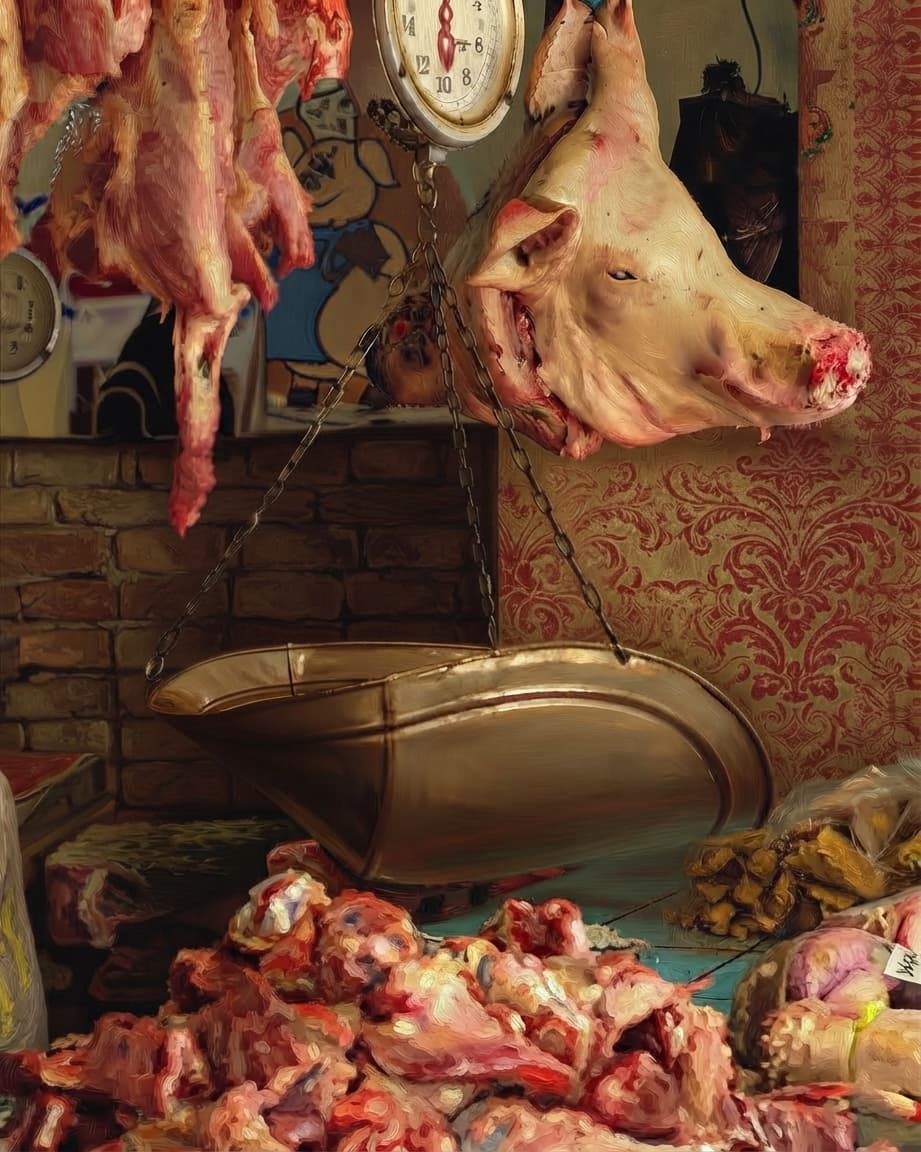
You step in and the light dies. Dark enough that you stop for a second while your eyes catch up. The kind of dark where you have to feel your way a little at first. The floor is wet and stays wet, water running off from someone rinsing a counter, blood going down with it, your shoes sticking a little with each step. It stinks in there. Not a bad stink. The honest stink of meat and animal insides and things that never quite dry out. The smell gets into your clothes. The heat coming off the walls is thick, sitting on you like a weight. The air is heavy with it.
Women in rubber aprons at their stations, permanent positions they've held for twenty years. Swatting flies with one hand and butchering with the other, calling orders across the aisle in voices worn raw from years of it. Cuts hanging off hooks, organized in a way that makes sense only to them. Organs in bins, organs in buckets, organs piled on tables. Nothing thrown away. The whole animal is there, accounted for, being transformed into something. Comedores packed in tight between them, small stalls with three or four stools, selling soup and rice and beans to the people who work here, to the people who come to buy meat, to anyone hungry enough to know where to find good food.
The light that does come in is diffuse and gray, filtered through whatever gaps exist in the metal roof. It's like being inside something that's just barely alive. The heat makes everything shimmer a little. Water drips from somewhere. A woman laughs. A man yells an order. You can hear every sound clearly even though it's loud, because the metal amplifies it, throws it around. It's the kind of place that gets inside you.
I found a heavy woman in a flower-printed apron working three giant stainless steel pots. Steam coming off all of them in clouds, making the space even more close and humid. She was jolly, loud, the kind of person who does this every day and still likes people. Like she woke up that morning and decided she was going to enjoy serving soup to whoever walked up to her counter. I asked what she had.
Sopa de res. Sopa de pollo. Mondongo.
The first two I knew. Beef soup, chicken soup. The standards, I'd had them a hundred times. Mondongo I'd heard about and never tried. Tripe soup, cooked down for hours with vegetables and broth. There's a whole route for it in Masatepe, a town that's built its reputation on the stuff, restaurants making it the same way for eighty years. That's the pilgrimage. That's where you're supposed to have it for the first time.
I wasn't in Masatepe. I was in Matagalpa with a head full of Toña. And I'd had tripe plenty of times in pho, pale thin rubbery strips floating in the bowl, the kind of thing you eat around instead of eat. Nothing special. Fine. Most people won't touch it at all. Most people are scared of anything that comes off a part of the animal they'd rather not picture.
Standing there watching the steam come off those pots, it felt like the moment anyway.
I pointed at the mondongo.
She ladled out a huge bowl and handed it over grinning, plastic spoon and all. I took a stool next to a few men eating theirs and nobody made anything of it. She kept talking to me the whole time in fast Spanish, the men adding their own comments, me catching maybe twenty percent of it and laughing along anyway. Easy. Warm. Like I'd been coming here for years. The only ones who found me interesting were a couple of kids who drifted over to watch the gringo eat, which is fair.
Then the soup.
Not the pale rubbery stuff from pho. This tripe was thick, colorful, layered, honeycombed on one side and smooth on the other, and it had been cooked so long it came apart against the roof of my mouth without chewing. The broth had gone brown and heavy, the color of earth. Yuca in there, starchy, half dissolved into it, making the broth thick enough to coat your mouth. Sour orange cutting the fat every few bites so it never got to be too much, never got cloying. Things I couldn't identify and didn't need to.
The heat of it was immediate. Not just temperature but the kind of heat that comes from fat and collagen and hours of cooking. It warmed my hands through the bowl. It warmed my chest going down. I could feel my body absorbing it, needing it, responding to it.
Around the fourth spoonful I stopped thinking about the bus.
I ate the whole thing in that dark wet room that smelled like a slaughterhouse, with two kids watching me and the cook checking in every couple minutes to make sure I was into it, and it was the best thing I'd eaten in months. The soup kept revealing things, another layer of flavor, another texture, something else that had cooked down into it. The yuca got creamier as it cooled. The orange stayed bright all the way through. The tripe dissolved almost completely by the last third, turned into something more like a component of the broth than a separate thing.
I was sweating by the end of it, the heat of the room and the heat of the broth working on me at the same time. Sweat coming off my forehead, running down my temples, soaking into the collar of my shirt. And somewhere in there the Toña came out through my pores. I could feel it happening. The poison working its way out. My head cleared. The pressure behind my eyes let go. The nausea that had been sitting in my stomach since I woke up loosened and dissolved. I felt fed in a way that went deeper than hunger. Nourished, actually nourished, the kind of full that comes from food that knows what it's doing.
When I stood up off that stool I had legs under me again. I had energy. I had a clear head. I could think about things without the Toña getting in the way.
I walked the whole way down to the south market to catch the bus. The sun was different now. The street noise didn't bother me. The heat felt like something I could move through instead of something pressing down on me. I got there early, bought a ticket, and got a seat by the window.
The bus filled up slow, then all at once. Bodies pressing in, the smell of sweat and diesel, someone's groceries piled in the aisle. The chicken bus groaned to life, the engine loud. We pulled out of the station and headed south toward Managua, the suspension bottoming out every time we hit a pothole, which was often.
I slept. Deep sleep, the kind you don't wake up from until someone shakes you. The kind where you're not dreaming, you're just gone. Three hours gone. The bus rocking, the engine roaring, and I was asleep through all of it.
When I woke up we were in Managua.
More field notes
Read the guides that get you here
The stories are what it feels like. The guides are how you actually make the move.
Browse the guides →